
(An excerpt from the novel Keeping, unpublished. Copyright 2015 by Pam Wilson. All rights reserved.)
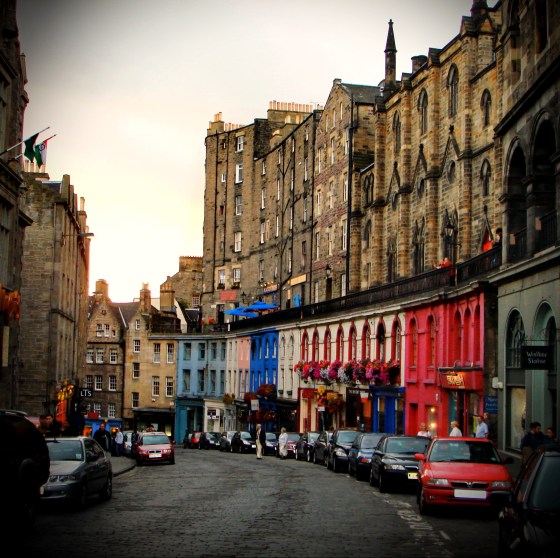
Where Do Their Souls Dwell
March 2010
Meg walks from her hotel to the station to meet Gunnar’s train. The Waverley train station is on the other side of the Castle Rock and across and beneath the Mound; the train lines separate the old medieval city from the Neoclassical and Georgian “New Town” with its well-laid-out streets and architecture.
She looks on the board to see at which track the train from London will be arriving, then glances at her watch. Twenty-five minutes. She buys herself a cup of tea, adds sugar and cream, and slowly sips this comfort beverage as she waits for time to pass. She is nervous. This meeting has the potential to go so many ways. I’m hoping for the best, she tells herself. It feels so strange. Here I am, on the other side of the world, twenty-five years later. I’m a link to her life. He is my link to her life. Somehow, I hope, he will be able to provide the answers. And somehow, I think he hopes I’ll be able to help him, too. We’ve been spilling our souls to each other in our letters. Will it be as easy face-to-face?
As the time approaches, Meg moseys toward the track, figuring out which side of the platform will be the arrival side where the passengers will dismount. She walks down the steps from the large hall of the station to the real workings of the place, where the world-changing iron machinery operates. There’s a magic to train stations, and she senses it here. Suddenly, she feels the vibration beneath her feet as the train from London approaches the station and rolls in beside her. There are so many cars. Where will he be? She wonders as her eyes scan up and down, waiting for the doors to open.
Simultaneously, all of the doors open and passengers begin pouring out. Some carry briefcases, while others have larger suitcases. Her eyes scan back and forth until she spots a slightly built older man, hair grayish and tousled, face chiseled, stepping onto the platform. He carries a small, worn brown leather valise. She has the advantage of watching him for a few minutes before he spots her, so her mind races with memories of that face, though it was so much younger then. He’s more age-worn, wispier, more bent, as if he might blow away in a strong gust. When his eyes catch hers, she smiles and nods in acknowledgement. Soon, he reaches the staircase where she stands.
“Well, hello, Dr. Meg Chandler,” he says in a voice still surprisingly deep given the lightness of his physical being, a smile creeping onto his visage. “It’s very nice to see you,” he says as he extends his right hand to Meg in a handshake. She returns the gesture, smiles at him, and asks, “How was your trip?”
“From London? It was fine. Four or five hours on a train is an ideal length for a trip. Long enough to read a good chunk of a book. And the scenery wasn’t bad to look at, either.” Changing the subject, he says, “Should we head upstairs?”
“Sure,” she agrees. “Do you have all your luggage?”
“Oh, this bag is the only thing I brought, just for a night,” he responds, gesturing to the well-used leather case. “I left the rest in London. And how has your visit here in Scotland been thus far?”
She laughs. “Oh my goodness, it’s been full of adventure. But good, on the whole! I’ll tell you about it over lunch,” she promises. “Where would you like to go?”
“It’s been years since I’ve been to Edinburgh,” Gunnar says. “I remember a few places, but it’s hard to know if they’re still around. Let’s walk over into New Town since that’s closest right now. I recall a nice Victorian pub you might like, not far from here, just off Prince Street.”
They walk a few blocks. Gunnar pauses and looks around, trying to remember exactly where to turn. Finally, they turn a corner, and he shouts, “Aha! The Café Royal!” He turns to Meg and confides, “This will be a lovely place for lunch and a bit of Scotch.”
Upon entering, Meg feels as if she’s stepped into a century-old painting. Warm, reddish-brown carved wood paneling surrounds them. The ceilings are patterned into large, geometrically intricate designs outlined with wood trim and featuring a number of colors. One wall is lined with stained glass images of sporting gentlemen, while another features ceramic tiles made into paintings. Chandeliers hang down from the high and ornate ceilings, while sconces from the walls light up the place but dimly. Gilded pedestal columns run across the center of room, surrounded by a dark wood island bar unlike anything Meg has ever seen. Colorful bottles of every type of known liquor line the shelves in the center of the bar. A white crown molding lines the tops of the wallpapered walls, its carved design highlighted with gilding. They seat themselves in a large booth under the arches of the windows facing the street, surrounded by warm colors of wood, golds and burgundies. The place exudes a very welcoming aura. Luscious smells emanate from the kitchen as well.
“Will this do, d’ya think?” Gunnar asks with a sly smile.
Meg’s mouth is still agape as she assays the surroundings. “This is fabulous,” she gasps. “I may stay here until it’s time to catch my plane in a few days.”
He chuckles. “Yes, I’ve had some good memories here. What can I buy you to drink?”
“I’m not too much of a drinker,” she says. “That is to say, I don’t know much about liquors, especially those here in Europe. I mostly drink wine, when I drink.”
“Well, dear Meg, we must train you to drink Scotch whiskey, since you’re in Edinburgh. Let me choose one for us. And we can order some pub food for lunch, too. I know just what you’ll like,” he says with confidence. Gunnar motions the waiter, who comes over to the table, and in that manner of older men who are accustomed to ordering for women, he orders Meg both a drink and food. This feels so odd to her, to have someone deciding on her behalf.
“Please bring us a bottle of Auchentoshen Three-Wood,” he says. “And then, let’s see: a Grilled Salmon Salad Niçoise, a Beef Pie, and some Wild Mushroom Risotto. And extra plates, so we can sample them all. Also, please, a bottle of water, no gas.” The waiter makes note of the choices, tells him it’s a fine selection, nods to Meg, and walks away. Gunnar turns and looks at her in a sustained way for the first time as they face each other across the booth.
“Ah, now that the ordering’s done, we can get to know each other. So, the first order of business is: how are you, Meg?” He reaches across the table and covers her hand with his. “I can’t tell you how marvelous it is to be able to meet you and spend time with you in person like this.” He squeezes her hand, then withdraws, still making strong eye contact.
Meg looks at his face closely, tracing the lines and grooves of age with her eyes. He has character; that cannot be denied. “It’s good to meet you, Gunnar. Again, I guess, though I don’t feel that I ever really met you properly back then,” she says, smiling through the awkwardness. “I’ve enjoyed our email correspondence.”
“As have I, my dear,” he nods. “As have I. You are quite an exceptional woman. There are not many women who can hold their own with me, but you’ve proven that you can do so, at least in writing.” He chuckles. “We’ll see how it goes in person!”
Meg is not too sure what he means by this. In some ways, it feels like a challenge, though also a testament to his own belief in his personal, and male, superiority. She is feeling cautious. “Well, I doubt I can hold my own with the Scotch, that’s for sure,” she says with a slight grin. Just at that moment, the waiter arrives with the bottle of Scotch Gunnar ordered.
“Here you are, sir. ‘Tis an incredibly smooth triple-distilled single malt, aged in three different barrels. It tastes a tad like a nutty apple pie with ginger and a whiff of chocolate. An excellent choice. Will the lady have a glass?” Meg nods.
“Thank you,” Gunnar says, then pours a glass for Meg and one for himself. “Now, I need to teach you how to drink Scotch,” he remarks. “You drink it differently than wine. When you drink wine, you bring air into your mouth to mix with the wine. However, with Scotch, you try to keep the air out—take a sip, hold it in your mouth and maybe swish it around for a few seconds before swallowing. It’s also okay to add a bit of water to it.”
She tries it. The flavor is intense, burning her mouth. Yet the aftertaste is not unpleasant. She tries another sip, leaving this in her mouth longer before swallowing. Not too bad. She likes the sugary apple flavor.
“So, back to you, Meg. Tell me about your life.”
She takes one more swallow and can already feel the alcohol working. Not wanting to spend forever talking about herself, she tries to summarize fairly quickly: where she teaches, what she teaches, the kind of small private college environment in which she is immersed (which is quite different from the large and prominent universities where he has taught). She tells him about raising her son after her divorce, about being involved in a new relationship.
“It’s good you didn’t marry again right away,” he says. “That’s an error I’ve made more than once.” He grimaces, then grins. “Take some time to be alone. How much grief I would have saved myself if I’d heeded that advice so many years ago!”
“Though you’ve been married to some very smart women, from what I can tell,” Meg comments in appreciation, remembering the ones she met and the stories she’s heard. She asks him about his most recent wife and stepchildren, and he fills her in on his retirement years living in Paris again now, late in life, after spending time there as a young man.
“Paris is probably my favorite city in the world,” Gunnar notes as he pours himself another glass of Scotch. “Perhaps it’s because I fell in love with it when I was a very young man. I do think there’s something about those places and people you ‘meet’ when you are at a point in your early life when you’re the most impressionable. They leave an imprint upon you, and even though you may find so many wonderful places, and love or befriend so many other people along the way, nothing quite matches that magic you felt the first time someone or someplace really made you feel alive. Alive! And that’s what Paris did for me. Living there with Olja and little Derek and Kata was the most dreamlike part of my life, looking back. I’m trying to recapture that now, I suppose. And though it’s wonderful now, it will never be the same as it was back then.”
“Hmmm. I imagine you’re right.” Meg thinks for a moment about her time in Texas, as a young woman, and its magic in her life. “Gunnar, I wanted to ask a little more about you and Olja,” she begins after taking another sip from my glass of Scotch. “Where you had grown up, your family background, and so on. Was she also an academic? Oh, I also noticed in an online bio that you were born in India—how did that come about? Where was your family from? Sorry, too many questions!” she apologizes with a laugh.
“Ah, yes. No problem! My life’s been a bit complex! My parents were Lutheran missionaries. In 1912, just after they got married in Blair, Nebraska, where my father attended a Danish Lutheran college, they embarked upon a three-month journey to finally end up in a tiny missionary community in German East Africa,” he says.
“Really? That’s fascinating!” Meg remarks.
“They were both Danes. I was actually a Danish citizen until 18. They were there in Africa four years while my father waited for a posting to India. In 1916, it came through. My oldest two brothers were born in Africa, the rest of us in India. They had a total of eight kids. Many years went by, and my father’s affiliation changed to that of an American Lutheran church. In the mid-1930s, the American Church posted my father to Japan, where we stayed until 1941, when relations between Japan and the U.S. were worsening and all U.S. nationals in Japan were advised to leave,” he explains.
Meg nods, transfixed by his story. She urges him to continue.
“We moved to Hood River, Oregon, where my dad wanted to work with the Japanese immigrants there since he had learned to speak the language well. Then boom! came Pearl Harbor, after which we witnessed the incarceration and forced removal of the entire Japanese community there. It was heartbreaking. My dad went to help teach at the Army Japanese Language School at the University of Michigan, so we spent most of the war in Ann Arbor. All four of my older brothers were in the service during the war: two in Europe, two in the Pacific. We moved back to Oregon in 1945, halfway through my junior year in high school. I graduated from high school in Hood River then took off for college back in Michigan.”
Gunnar is on a roll, telling his story. However, just at that point, the waiter brings their food. They decide to share it all, so they serve themselves from each of the three dishes. On first taste, everything is delicious. He’s ordered a nice balance of flavors and textures, I’ll give him credit for that, Meg admits. Once they indulge in their initial feeding frenzy, Gunnar continues.
“So, I met Olja in college, second year I think. She was from steelworking people in the Homestead neighborhood of Pittsburgh. A brilliant girl, she obtained a nationally competitive scholarship in biology. Her father, though well-educated as a pharmacist, was a scary and violent man, a schizophrenic who had been in and out of mental hospitals. Her mother did a bad job of protecting her two daughters from their father’s emotional tempests. Her father made Olja into a substitute for the son he never had, pushing her to be a scientist while at the same time letting her know no woman could ever do that!”
“What a mess—the combination of mental disorders and personality issues seems very intense,” Meg notes. “Did her parents die before she did? Didn’t you tell me that Olja’s sister had also committed suicide?” He nods.
“Gosh,” she says. “You know, Gunnar, I don’t know much about psychology, but one marriage counselor I saw had an interesting approach to his therapy. He was interested in our parents, our grandparents, our great-grandparents—at some point, I think I said, ‘You know, I really don’t think that my great-great-grandfather, who I never knew, has had much impact on this marriage.’” Gunnar and Meg both laugh.
“Well, I imagine he may have, indirectly,” Gunnar says. “They say even traumas can be inherited and passed down through generations.”
“Yes? That’s intriguing,” she says, thoughtfully. “Like genetic memory? Hmm,” she thinks for a moment, then continues. “But I did find it interesting to think about how the cultures that meet in each marriage, and the new cultures that are created within each family—not only ethnic cultures, but also the dominant personality types and what becomes normative behavior, expectations, pressures, tensions, etc.—do indeed have an influence on us in so many ways. At the very least, they provide us with our earliest models of the way we might see the world, the lenses through which everything later is perceived: the way life should be structured and the way people are expected to act, the dreams we are expected to have, the ways that we reward or punish ourselves for our perceived accomplishments or failures.”
“You’re a perceptive woman, Meg. I appreciate the way you apply your anthropological understandings to these personal issues. Good meld of theory and practice! Go on,” he urges.
“Well, this is all so interesting to me,” she admits. “I’m fascinated by your account of growing up in a missionary family, the youngest child of much older parents, with many layers of cultural transplantation. Danish-Americans in Africa and India—and Japan in the years leading up to WWII. Wow. How had they ended up in Nebraska—were they both born in Denmark, or were they children of immigrants?”
“They were Danish,” he says, as he takes advantage of his break from talking to eat some salmon salad and beef pie.
“I’m also touched by what a position of irony your family must have been in, living in Oregon during the war, with such affinity for the Japanese but seeing those all around you vilified and rounded up as potential enemies of the state.” Gunnar, chewing on his food, nods in agreement as Meg says this.
“My mother’s father was a Danish merchant from Aarhus who had received ‘a calling’ and, in midlife, moved his family from Denmark to the U.S. to study to be a minister at a tiny Danish Lutheran college in Nebraska. He ended up as a fellow student with my dad. His oldest daughter, my mother, was a few years younger than my dad, and my parents met and fell in love and married. My grandparents eventually returned to Aarhus, where my grandfather got a church assignment. I remember visiting these grandparents in Denmark when I was a child in the 1930s. We went from Japan to Denmark via the trans-Siberian railroad and spent the summer there.”
Meg looks at him, wide-eyed. “The trans-Siberian railroad! Oh wow, that’s something I wish I could do. I’ve always been fascinated by those long train journeys, like the Orient Express.”
“I remember it very well. I’d never seen anything like the vastness of the Russian steppes. I remember crossing Lake Baikal on a ferry, to link the two ends of the train line since it did not cross the lake. The landscapes were broad and sweeping. Sometimes monotonous to a young boy like me, but we brought plenty of books and drawing materials so I could sketch some of the scenes. We had our own little cabin for our family, but I liked to leave our cabin and walk up and down the length of the train through the various cars. Ours was pretty posh, but some of the cars were filled with masses of working-class Russians just traveling from one town or region to the next. I would meet Russian children and play with them. Even though we didn’t speak the same language, it was easy to communicate as children, and the concept of play seems universal. We would chase each other up and back through the train cars until an adult would grab us by the scruff of our collars and make us settle down. Sometimes, a family would share its food with me, with a babushka pulling out containers of pickles and beets and herring and black bread. To this day, the smells of some foods immediately transport me back to those days spent traveling across Russia.” He empties his glass of Scotch and fills another.
“Those are amazing childhood memories to have,” Meg says, just imagining what that trip must have been like. She shakes her head in wonder. “Your younger years were absolutely distinctive, and such an exposure to the world in all of its richness! You’ve experienced places and times in history that most of us can only imagine through reading books or watching movies. That period between the two World Wars always fascinates me, because so much change was happening in the world so quickly. Here in America, of course, we hear mostly about the Great Depression years and their hardships, but you experienced those decades very differently in India and Japan. And Russia and Denmark.”
“Yes, I suppose I have had a most unusual upbringing. Those experiences contributed greatly to who I became, and who I am. And I’m sure they influenced my children, indirectly, as well. That concept from your marriage counselor is quite apt,” Gunnar notes, finishing off the risotto. Meg is full as well. She’s still sipping on her Scotch, slowly, while she notes that Gunnar is midway through his fourth glass. The bottle of Auchentoshen is close to empty. This man can drink, she thinks to herself.
Meg reflects more about the concept of familial memory and how it shapes us. “I know my own family had an intensity and a drive that’s evident in both of my sisters and me. Although we’re different in personalities and styles, we all internalized the aspirations of both our mother and our father, as they synergized into something that’s distinct from each of them but that we all share among the three of us. My father’s hard-driving analytical mind and critical approach to life married to my mother’s compassionate humanitarianism and quest for social justice—those are the tensions that’ve shaped me as well as my sisters.”
“What do your sisters do?” Gunnar asks. “And where do you fit in the birth order?”
“I’m the oldest. Melanie is a medical researcher, while Beth is a clinical psychologist. We’re all Dr. Chandlers, which made our father proud, since he always pushed us academically. A family of overachievers!” she laughs. “So this is all helping me to see what cultures and personalities shaped Kata, too. Of course, there are always those questions as to how much is cultural and how much biological….” Her voice trails off. “I’ve always tended to lean to the cultural side, although once I had a child of my own, I began to see that he was born with a certain disposition that I couldn’t change no matter how hard I tried—not a clean slate or a lump of clay waiting to be molded!”
“You’re absolutely right, in that regard,” Gunnar nods. “Absolutely.”
“And so, as parents, there are all those things you need to do to make sure they are exposed to what you think are all the ‘right’ things. But in the end, I think it’s like the Kahlil Gibran poem: ‘Your children are not your children; they are the sons and the daughter of life’s longing for itself. They come through you, but not from you, and though they are with you, they belong not to you.’”
“Ah, yes. I’ve always been fond of that one, myself,” Gunnar nods. He’s beginning to look sleepy.
“Do you know the Sweet Honey in the Rock musical version of that poem? Their a cappella song?” Meg asks.
“Yes, oh yes. I do remember it now. Powerful harmony!”
“Yeah. I sang that song a lot during my pregnancy, just to remind myself that the little being budding inside me would have a life and soul of his very own,” she remembers aloud.
“Ah, children,” Gunnar muses. “You know, it’s interesting. I realized some time ago that I’ve had exactly the same number of kids as my dad did—eight—if I’m allowed to count step-children.” He pauses here, remembering. “Yes, our children are parts of our heart, and when their paths run contrary to what we want or expect for them, our hearts can crack and split like the nucleus of an atom, causing nuclear reactions in our souls,” he says, looking solemnly into his nearly drained glass of Scotch.
“Well, Meg, our need to talk about Kata is imminent,” he continues. She nods. “But I think I’d like for us to take a walk first. Shall we?”
He rises, puts on his coat and scarf and walks away to find the waiter to settle the check. Meg stands and bundles up for the blustery March day, her mind full of Gunnar’s stories. However, he’s right. We still have much talking left to do.
They begin walking, noting that the cold wind has picked up in the last couple of hours. Soon, they come to The Royal Circus, a large circular green park diagonally crossed by Circus Place. There they see signs for a photographic exhibit of Scottish photojournalists at the nearby Edinburgh Photographic Society’s Photographic Exhibition Centre.
“You’re a photographer, aren’t you?” he asks her. “Would you like to see this?”
“Yes, of sorts!” Meg laughs, “and yes, that sounds like a good plan.”
The exhibit is not large, but the images of Scotland and its people are magnificent, providing each of them with fresh views of the broad scope of life in this ancient land. They admire the photographs of rugged landscapes and share stories about what parts of Scotland each has visited. Meg recounts some of her tales about her very recent adventures with Melanie in the Highlands. She is also particularly enticed by the street photography, giving her glimpses into the everyday life of Scottish cities. Meg especially enjoys street portraits, so this collection does not disappoint as she encounters numerous images from across many decades picturing various persons in their local environments. Sharing this with Gunnar and seeing which images touch him the most, and which he reacts to the strongest, becomes a bonding experience.
The odd couple, the septagenarian man and the woman twenty-five years his junior, leave the museum and decide to walk across and up the Mound toward the Old Town. No serious talk as they walk, just comments about their surroundings. Gunnar notes that he needs to find a room for the night, so they decide to stop back at Meg’s hotel to see if it has any openings. They walk to the Castle terrace, pausing to admire the view across the city, then descend the hill to the Grassmarket. Arriving in the hotel lobby, he checks in and leaves Meg in the lobby as he deposits his valise in his room. Upon his return, he asks the concierge about the best pub close by and is directed across the Grassmarket to the White Hart Inn.
“It’s the oldest pub in the city!” the concierge exclaims in a thick Scottish brogue. “Even Bobby Burns drank there!” Gunnar tips her for her help, then the two walk across the square to the old Inn. The door boasts an ornately carved green frame, the pediment for which encloses a carved and painted image of a white stag. The building bears a sign saying it was established in 1516.
They enter into a dark room that feels old, indeed. The whitewashed ceilings have exposed dark wood beams every few feet, upon which dozens of pewter beer steins hang. The bar furnishings themselves, as well as the walls, are a very old wood stained deep brown, while the bar itself is crafted of a slab of lighter-stained wood. The bar stools and seats in the booths are covered in coffee-colored leather. Gunnar and Meg find a booth and sit cozily, sheltered by the high walls.
“I suppose it’s now time for you to be introduced to Scotch ale,” he says, ordering two bottles of Innis and Gunn. “This is called ‘wee heavy’ around here,” he laughs. “It’s stronger than Scottish ales. This particular brand is aged in rum casks, so it has a spicy edge to it.”
Meg finds the “wee heavy” good though a wee bit strong for her taste. She’s beginning to see that Gunnar’s life revolves around drinking. He’s held his own so far, however. They toast each other.
“Sláinte mhaith!” Gunnar says and helps Meg learn to pronounce it correctly. “To your health!”
“Sláinte mhaith!” She tries to say in return, butchering the Scots Gaelic. He laughs.
“Close enough for government work,” he says with a wink, then his facial expression becomes more serious. “So, we began to talk about parents and children at lunch. I’d like to share some more with you about my experiences of losing Kata. I’ve been thinking a lot about what to say to you, these last weeks, as I’ve anticipated our meeting here.”
“I know it’s probably hard to talk about,” Meg acknowledges. “Reviving my own memories of that period has felt both emotionally troubling, on the one hand, but somehow cleansing and healing, on the other.”
“Yes, yes, yes,” Gunnar says, downing his first bottle of wee heavy and catching the waiter’s eye to indicate his need for another. “Please don’t apologize at all. It’s actually been so gratifying that you found me and that we’ve been corresponding. And now, getting to meet like this? It’s wonderful, actually.”
He begins to fumble in his pockets, as if searching for a lost item. “Hold on, I have something here somewhere,” he says apologetically. Finally, having found it, he keeps it clasped in his hand and looks at the woman across the table, realizing that had his daughter lived, she would be the same age. “I’d like to give you something, Meg. This was Kata’s, and I’d like for you to have it.” He opens his hand. In his palm is a lovely and unusual pendant: a deep yellowish-brown stone in a teardrop shape, wrapped in a warm gold frame with a gold swirl almost like a Celtic knot over the lower part of the teardrop. Meg takes it and handles it gingerly. As she looks at it more closely, she realizes it’s not a stone at all.
“Amber?” she asks.
“Yes, cognac amber from Denmark,” Gunnar says. “It’s a necklace I brought back to Kata from a trip to Denmark when she was about twelve. She wore it every day for years, it seems. It was her favorite. Then, after her mother died, I rarely saw her wear it. I found it at my house decades ago, and I’ve kept it on my dresser to remind me of her. But it would mean so much to me for you to have it.”
“Gunnar, that’s so thoughtful of you. But…,” she pauses. “I really feel this is precious to you. You need to keep it,” Meg protests.
“No, I’ve put a lot of thought into it. I even took it to a jeweler in Paris and had it cleaned up for you. Please accept it—and wear it. From me to Kata to me and now to you. It will keep her memory alive.”
Meg turns the piece of gold and amber over in her hands, then closes her hand over it and squeezes it as if to absorb its spirit. “I’m touched, Gunnar. I really don’t know what to say. Thank you.” Meg strokes the amber then puts the necklace around her neck. It feels good. Gunnar smiles at her.
“Meg, I’ve needed to talk about Kata for a long time now, and I’ve had no one who was able to—and willing to—remember her with me. This is a very healing process. I’m almost 80, you know. I need to resolve all of this grief and guilt I’ve carried around with me so many years, or at least as much as I can.”
“Grief, I can understand. Why guilt?” Meg asks, observing his face closely.
“Oh, you know,” he begins, looking toward the window and away from eye contact for a moment. “Survivor’s guilt, I guess. The guilt of a parent who feels, somewhere deep in his heart, that he should or could have done things differently. It’s the damned, cursed little voice that keeps taunting, ‘What if you had done this otherwise? Or that?’ Even after twenty-five years, I still lie in bed some nights, besieged by my own demons, wishing I could only know what choices I might have made that would have kept her from taking her own life.”
Meg nods. “That must be an agonizing feeling.”
He reaches across and takes her hand in his. “My dear Meg, I hope you will never have to suffer through the pain of losing a child. Children are meant to live beyond us, to move this world forward past us. As you quoted Gibran earlier, they are the sons and daughters of life’s longing for itself. But they are also our own sons and daughters, our own flesh and blood and hearts and guts. We infuse them with all of our hope, give them the best of ourselves—well, hopefully, and there’s where the guilt and doubt and fucking sorrow come down and wash over those of us who lose them.” Gunnar begins sobbing, pulls his hands back to reach into a pocket and pull out a handkerchief—a cloth handkerchief, which he uses to dab at his eyes as they rim with tears. “I’m sorry.”
“Gunnar, there’s no need to apologize. Keep telling me about you and Kata,” Meg urges.
“Ah, she was so beautiful, and she had such a gentle and amazing soul,” he says softly. “She was so precious to me. And she broke so easily, too easily. I couldn’t protect her from all the bad things in the world,” he sniffs. “She was such a sensitive and insecure young girl or woman as an adolescent, so unsure of her place in the world, so uncertain about whether she was loved or would be loved. I loved her, God damn it!” he shouts explosively, banging on the ancient wood table, as heads turn around the bar, then turn away again seeing that it is only a display of emotions. I suppose bars get their share of emotional outbursts unleashed by spirits, Meg thinks.
“I loved her, but I don’t think I let her know it well enough,” he admits sadly. “When I left her mother—to save my own sanity, damn it, because it was so fucking hard living with a schizophrenic wife!—I didn’t know how to extricate Kata and Derek from the mess of their mother’s life, too. They loved her, they were enmeshed with her, and she held them tightly to her and threatened me if I should I try to take her children away. I mean, Meg, oh Meg,” he clutches my arm, “how could I take a woman’s own children away from her?”
Meg shakes her head, sadly, not knowing what to say.
“How could I keep them safe and protected and feeling loved, with me, while also distancing myself from the damnable hell of a marriage I found myself in?” He pauses to take a breath and finish off his second bottle of wee heavy. The bartender quickly sends a third to the table. “So, at some level, I escaped and left them behind. And that act in itself has haunted me my entire life. I saved myself but, in honoring their relationship to their mother, I sacrificed my children. Oh, Kata,” he wails as he lays his head down on his hands, “I’m so sorry. I’m so sorry.”
Meg reaches across and tentatively puts her hand on his shoulder, hoping that some human touch might comfort him. She mentally sends him energies for strength and understanding, having no idea how to comfort him. He sobs for a few minutes then lifts his head to continue, still in consternation.
“I really didn’t know that she would kill herself. I just really didn’t know,” he says, to himself more than anyone, and Meg is no longer sure if he’s referring to Olja or Kata—or both his wife and his daughter.
“Why don’t we walk some more while we still have the light outside?” she suggests, thinking that exercise might help dissipate some of this liquor in his blood. Gunnar slowly composes himself, gathers his coat, and they rise. Meg walks to the bar to settle the tab, then the two step out into the crisp late afternoon in the Grassmarket. They walk past the hotel and up Grassmarket to where Cowgatehead and Candlemaker Row branch off. They turn right onto the smaller street. To their right, they follow a long stone wall where an open archway beckons to them, with steps leading into Grayfriars Kirkyard and Cemetery. Walking silently through the centuries-old churchyard, each is enwrapped in private memories. Wordlessly, they return to the street. They do not talk much as they walk, each just sensing the presence of the other. Soon, the modern architecture of the National Museum of Scotland looms on their left. Gunnar catches Meg’s eye, motions to the door and enters it, with Meg following. As they stroll through the Scottish History and Archaeology galleries of the Museum not unlike a father and daughter, the two professors, conjoined by their shared ghost, absorb the history and the stories told by the items or artifacts in the exhibit. They are in a mutually introverted mode at the moment, a quiet and sacred togetherness.
After leaving the Museum and continuing up the road, Gunnar and Meg decide to step in to Doctor’s Pub on Forrest Street at Teviot for dinner. It’s another one of those grand old pubs with dark wood and rough hardwood floors, positioned with the doorway at an angle across a street corner. However, this pub is full of medical memorabilia, situated in the University area of the city a few blocks south of the Grassmarket, not far from the ancient medical school. Drinks are ordered: more Scotch for Gunnar, red wine for Meg, as well as Sausage and Mash and a Ploughman’s Tart to eat.
Gunnar looks at her sadly and begins, “Meg, I want to tell you about my last visit with Kata, in Austin. You see, Kata and I got into fights a lot. Usually, over the years, we would have those blowout arguments, a father-daughter power struggle, slinging words back and forth at each other, but end up feeling pretty close afterwards. Did you and your father ever have arguments like that?”
“Oh yes,” she replies, thinking about some of them. “Daddy and I have had many battles of wills, seemingly a contest of who was the most stubborn and strong-willed. Neither of us liked to give in.”
“Ah, I see. Good, that you understand. Actually, Kata and I had a little bit of a fight like that last time I saw her. About two or three weeks before she died, so it would have been sometime in October of that year. This was when she was in Shoal Creek Psychiatric Hospital there in Austin, and we had some of those fights again. I was harsh but honest with her. But it was different this time, because she was in the hospital.”
“That was when she had tried to kill herself and failed to go through with it, then committed herself?” Meg asks. Gunnar nods.
“She was in the hospital and complained to me that she was bored—she just wanted to get out. I lectured at her, ‘Kata, you ought to get out of here, if you feel like it, and get back to work. Stop mulling and feeling sorry for yourself over that fellow. There will always be other men to love. Losing love is not worth killing yourself over, damn it, if that’s what this is all about. Stop feeling sorry for yourself! Get back to opening yourself up to people. Why don’t you try staying here nights for a while and going back to work during the daytime?’ I just kept seeing her mother in her, seeing her reacting to things as her mother had, and I just wanted to shake some sense into her and get her to see the logic of the situation. I was so panicked and frustrated. Here she was, avoiding facing the reality of life by trying to kill herself. Just as her mother had. At least, that was my perspective. And it terrified me. But it also made me angry, I guess.”
Meg nods, trying to imagine what it would have been like to be a parent in Gunnar’s situation. This is new for her, since she has always identified with Kata’s perspective, in the past.
“And so the last night I was there, I took her out of the hospital for the day, and we went out to some place that had Italian food. We kinda joked and laughed at each other a little bit. We had this routine we used to do when she was younger. Every time she’d start to say, ‘Oh, Dad, I’m so ashamed. Oh, I’ve failed,’ I’d say, ‘Oh, poor little Kata.’ In a mocking tone. I’d remember how my mother used to scoff at me when I was feeling sorry for myself, ‘Poor little Gunnar, why don’t you go out into the garden and eat worms?’ Then we’d both laugh.”
Meg watches and listens. Gunnar is someplace else in his mind. Far away and long ago.
“After we were done eating, she said she wanted to go back to her house that she’d just moved into—where you lived—and pick up some music, because she’d been playing guitar and singing for other people in the hospital. That seemed like a good and healthy thing for her to do—you know, when you’re feeling bad but you try to do a little bit of something for other people. But she didn’t have any of her songbooks there at the hospital. She just had her guitar, so we were going to stop by the house. I said, ‘We’ve still got time to do that—to go back to the house so I can meet your new housemates.’”
“But then she changed her mind,” Gunnar continues. “She said, ‘Oh, Dad, I think I just want to go for a walk instead.’ So I said okay, and I asked, ‘Where do you want to go?’ Kata said, ‘I guess I want to go to campus to check my mail,’ so we walked over to the university, and she opened her box and took out some mail, looked at it, threw most of it away, and we walked back to the car.”
“And I said, ‘Kata, we’ve still got time to go to the house, if you want. I’d really like to meet your friends, your housemates.’ I knew how hard it was, how hard it would be for her to walk into that house and face all of you after what she’d done. She said, ‘Let’s just drive around a little while.’ So we got in the car and drove around a little while in downtown Austin, but after about two blocks, Kata said, ‘Oh, Dad, I’ve changed my mind. Let’s do go to the house.’ So we went to the house.”
“Really?” Meg says to Gunnar, shaking her head in wonder. “I had no idea you’d done that. And I wasn’t there. I must’ve been working late that day and missed you. No one ever told me.”
“Yes, we went to the house, where you lived, and I met your other housemates who were there. We sat and talked to them a while. And then I took Kata back to the hospital,” he says, remembering.
“And the next morning, I had the chance to take her out again. The doctor thought this would be therapeutic, and it did seem to be good for her. We drove around all over Austin. We drove up by Mount Bonnell, where we sat on the wall and looked out over the river, the lake. We just looked at the hills and the lake, and we talked. She was really thinking a lot about her mother. She wanted me to remember her mother with her. We talked and talked about her mother. We just talked about a lot of things, kinda like you and I have been talking today. We looked out over those wild hills around Austin—you know, from Mount Bonnell you can see so far, see the whole chain of lakes there—Town Lake, Lake Austin, Lake Travis, I forget, almost all the way up to Burnet. And all the hills, the magnificent hills. And so Kata and I looked out over all that and talked for hours. It was a special day. I felt so close to her. She felt so alive, so dear and precious, so open to me about her feelings and fears.”
He coughs, pausing for a moment afterward. “Then I took her back to the hospital and said goodbye to her. And I got on my plane and rode my plane back to Connecticut, not knowing it was the last time I would ever see her alive.” At this, Gunnar clenches his lips as if to try to hinder the emotions erupting from his heart.
This time, Meg reaches over and squeezes Gunnar’s hands as she watches the tears stream down his face. He takes out his handkerchief, by this time already soaked, and tries to stem the flow, but the tears keep flowing. Meg’s memories flash back a quarter century, to the image of the body hanging outside the back door of the house they shared together, of the blur of panic, chaos and heartbreak that ensued. For all these years, I’ve needed to understand what makes a 28-year-old woman decide to die. And mostly, I’ve needed to understand the meaning of her life to my own. She seemed so much like me, yet her pain was so different. Could she have imagined that at the end of his life, her father and her final best friend would travel across the world, still searching for answers?
Meg’s tears begin as well, in sympathy and co-remembrance. The two of them sit there, in Doctor’s Pub surrounded by archaic medical instruments mounted on the walls and in display cases, weeping together for Kata.
All rights reserved. Copyright Pam Wilson @2015.
 Pam Wilson, Writer